7 AI Myths Service Contractors Need to Stop Believing
If you’ve ever watched a Roomba spend 20 minutes trying to escape from under a chair and thought, “This is the tech that’s supposed to be smarter than humans?”—you’re not alone. Or maybe you saw the viral story where AI suggested using glue to keep cheese on pizza (yes, really), and figured the whole thing must be overhyped.
That skepticism is healthy. But it can also hold you back. Because AI isn’t a buzzword anymore. It’s here. It’s working. And it’s changing the game for the fire and life safety industry.
Let’s bust some myths.
Myth #1: AI Is Just Another Tech Bubble
Sure, we’ve seen tech hype before. Dot com. Crypto. NFTs. All had wild speculation, big promises, and eventual crash landings.
So it’s fair to ask: Is AI just another hype cycle waiting to pop?
The answer: No. Because while those other “revolutions” were mostly narrative-driven growth and speculation, AI is delivering measurable, real-world results. It’s not pets.com burning through $300M for a sock puppet ad. AI is solving actual problems.
Let’s look at the numbers:
72% of organizations are already using AI (up from 50% last year)
85% of executives see AI as a competitive edge
92% of large companies are seeing ROI, with an average return of $3.50 for every $1 spent
45% report doubling employee productivity with AI
That’s not speculation. That’s impact.
And AI isn’t new. It’s been quietly evolving for decades. We’re talking about a timeline that started with Turing tests in the 1950s, deep learning in the ‘60s, and IBM’s Watson winning Jeopardy in 2011. The buzz may feel new, but the foundation is decades old.
Myth #2: AI Is Too Hard to Use
I get it. AI lingo can sound like alphabet soup—GPT, LLM, fine-tuning, chain-of-thought reasoning… You could be forgiven for thinking you need a PhD to make sense of it.
But here’s the secret: you don’t have to understand how AI works to use it effectively.
Do you know what HTTP stands for? Or how TCP/IP works? Me neither—and I’ve worked in IT for 20 years. But that doesn’t stop us from using email or browsing the web every day.
AI is following the same curve web development did:
First it was code-heavy (you had to write everything from scratch)
Then it went low-code (WordPress-style templates)
Now we’ve hit no-code (drag-and-drop simplicity with tools like Wix or Shopify)
That’s exactly where AI is headed. ChatGPT, Perplexity, and Google’s NotebookLM are your no-code entry points. You can talk to them like a coworker and get answers, ideas, and content instantly.
Myth #3: AI Is Too Expensive
With all the talk of billion-dollar data centers and $40,000 AI chips, it’s easy to assume this stuff is out of reach.
But the truth is: AI can cost you nothing at all.
The free version of ChatGPT gives you access to one of the world’s most powerful AI models. You can:
Ask questions
Analyze data
Upload documents
Search the web
Create images
Even build a custom chatbot trained on your own data
All for free.
When you’re ready to level up? It’s $20/month. That’s it. You don’t need to invest in trillion-dollar infrastructure to get started.
And tools like Perplexity.ai and Google’s NotebookLM are also free or extremely affordable. So before you worry about cost, just try one.
Myth #4: AI Will Steal My Data
Now we’re getting personal.
As someone who works in an industry where customer trust is everything, I understand the concern. Nobody wants their private business info training some faraway AI model.
Yes, there have been issues. Early AI companies scraped data, watched videos, and probably pulled some stuff they shouldn’t have. But here’s the deal:
You control what data you give AI.
For general brainstorming, idea generation, or content help—free tools are fine. But for sensitive info (like salaries, customer details, or proprietary data), you have options:
Upgrade to paid plans that give you better privacy guarantees
Use local AI tools like LM Studio, where data never leaves your computer
Think of AI like email or cloud storage: You don’t stop using it because of security risks—you just create smart policies around how it’s used.
Myth #5: AI Can’t Be Trusted
Let’s be clear: AI will make mistakes.
In fact, ChatGPT gives a wrong or misleading answer about 15–20% of the time. I once had a chatbot tell me it didn’t know the answer—but was “very confident” about that fact. 🤷
So yeah, don’t hand over critical decisions to AI unsupervised.
But that doesn’t mean you can’t trust it. You just have to trust but verify.
Let AI:
Sort through large documents
Identify patterns in your data
Draft reports, proposals, or emails
Then let a human review and approve before sending anything critical. AI is like a super-smart junior colleague—helpful, fast, tireless—but not quite ready to run the place.
Myth #6: AI Will Take My Job
Let’s talk real.
Yes, AI is going to change jobs. But history shows us that automation usually doesn’t eliminate jobs—it just changes them.
Think of ATMs. People thought they’d eliminate tellers. Instead, banks opened more branches, tellers did more relationship-building, and the job evolved.
Same with spreadsheets and accountants. Same with calculators and mathematicians.
The same is happening in fire and life safety. AI doesn’t replace skilled techs—it replaces the repetitive stuff:
Scheduling
Documentation
Generating reports
Filtering customer calls
It frees up time so your people can do what they’re best at: real inspections, customer relationships, and problem-solving in the field.
Oh, and that whole idea that AI will replace your job?
It won’t.
But someone using AI just might.
Myth #7: AI Is for Other People, Not Me
Here’s the one I love busting the most.
So many people can see how AI helps other jobs: customer service, marketing, accounting. But they think their job is too specialized. Too hands-on. Too unique.
If you’ve got tedious, time-consuming tasks (TTTs), AI can help. The problem is, you’ve done those tasks so many times, your brain doesn’t even register them anymore. But they’re eating up hours of your day.
Ask yourself:
What’s one task I could do with YouTube playing in the background?
What do I do every week that’s boring, repetitive, or low-value?
Now ask ChatGPT: “How can I use AI to make this faster or easier?”
Boom. You’re off and running.
Just Start
AI can sound overwhelming. I get it.
But you don’t have to dive into the deep end. You just have to start swimming.
Pick one task. Try one tool. Ask one question.
You don’t need to be an expert to get value out of AI. You just need to start experimenting. That’s how I got here—one base hit at a time. Now AI tools have made me at least 10x more efficient in multiple areas of my work.
And that’s why I believe the future of AI in fire and life safety isn’t about replacing people.
It’s about amplifying them.
So go forth. Bust myths. Kill tedious tasks. And if you’re ever stuck, just remember: AI may not get tired of your BS—but it still needs a great human driving the ship.
Let’s get to work.
James Jordan
James brought AI to ServiceTrade and leads our artificial intelligence innovations as Vice President of AI.
AI Prompt of the month: Creating SOP Flowcharts in ChatGPT
If your company has a set of Standard Operating Procedures (SOP) it can be really helpful to visualize them as flowcharts. Adding such a visual can significantly enhance clarity and efficiency in any SOP.
Essentially, flowcharts serve as visual guides that map out a process step by step, making complex instructions easier to follow. This visual representation is especially beneficial for new employees or anyone needing to understand a procedure quickly, reducing the likelihood of errors. Lucky for us, we can have ChatGPT take an SOP and quickly generate a flowchart for us.
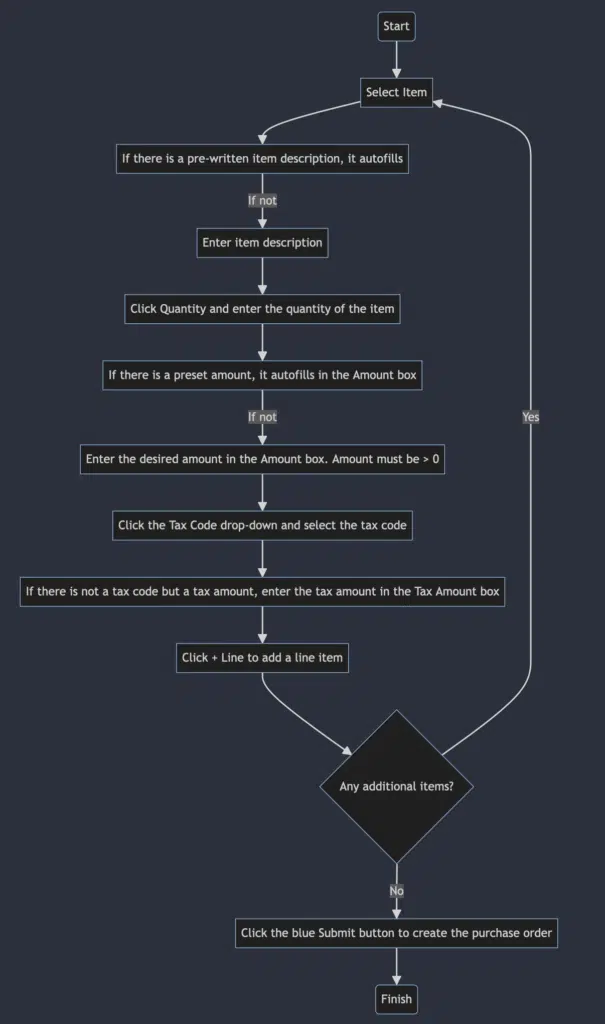
The example below is pulled from our recommended SOP for our PartsManager product. It’s relatively simple, but these flowcharts can be as complicated as your process, and are very likely to make that process even easier to understand.
The Prompt
Can you generate Mermaid code for a flowchart based on the “Adding Items to a Purchase Order” section of the attached PDF? Please avoid using the word “end” as a node name and do not include double quotes inside strings as that is not allowed in Mermaid.
The Result
Based on the “Adding Items to a Purchase Order” section from the PDF, here’s a Mermaid code for a flowchart that illustrates the process:
```mermaid
graph TD;
    A(Start) --> B[Select Item]
    B --> C[If there is a pre-written item description, it autofills]
    C -->|If not| D[Enter item description]
    D --> E[Click Quantity and enter the quantity of the item]
    E --> F[If there is a preset amount, it autofills in the Amount box]
    F -->|If not| G[Enter the desired amount in the Amount box. Amount must be > 0]
    G --> H[Click the Tax Code drop-down and select the tax code]
    H --> I[If there is not a tax code but a tax amount, enter the tax amount in the Tax Amount box]
    I --> J[Click + Line to add a line item]
    J --> K{Any additional items?}
    K -->|Yes| B
    K -->|No| L[Click the blue Submit button to create the purchase order]
    L --> M(Finish)
```
This flowchart starts with selecting an item to add to the purchase order and goes through all the steps such as entering item descriptions, quantities, amounts, tax codes, or tax amounts. It loops back to adding more items if necessary and ends with submitting the purchase order to create it.
The Flowchart:
6 Ways AI Can Level Up Your Commercial Service Business
As service businesses across industries strive to innovate and maintain competitive advantages, AI technology offers unprecedented tools for enhancing service delivery, optimizing resource management, and elevating customer interactions.
At the 2024 Digital Wrap Conference, ServiceTrade VP of AI, James Jordan, provided insights into how AI is reshaping the commercial service sector. His presentation highlighted the potential of AI to drive improvements in business operations and customer satisfaction. Inspired by his talk, this article delves into six core ways that AI can level up you business.
1. Enhanced Customer Interactions
AI can revolutionize your customer’s experience with:
Automated Communications: AI systems can manage and automate outgoing communications such as appointment reminders, service updates, and follow-ups, ensuring consistent and timely contact without manual intervention.
Personalization: By analyzing customer data, AI can personalize interactions by recommending specific services based on past preferences or suggesting optimal maintenance schedules, enhancing the customer’s experience and satisfaction.
Responsiveness: AI-driven chatbots and virtual assistants can provide immediate responses to customer inquiries around the clock, reducing response times and improving accessibility, which are crucial for customer retention and satisfaction.
2. Operational Efficiency
AI can enhance operational efficiency in several key areas:
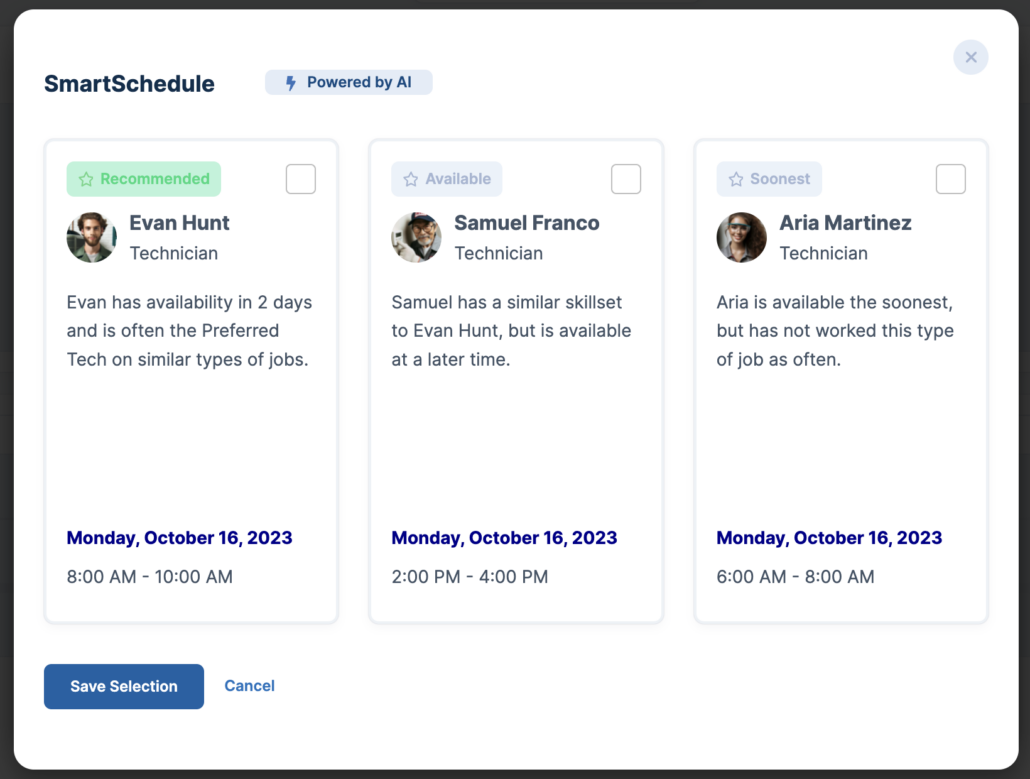
Smart Scheduling: AI uses advanced algorithms to optimize scheduling of service appointments, taking into account factors like technician availability, geographic routing, and urgent service requests, thus maximizing daily operations and reducing travel time.
Resource Allocation: AI helps in dynamically assigning technicians based on skill levels, location proximity, and workload, ensuring efficient use of human resources and reducing downtime.
Process Automation: AI can automate routine processes such as inventory management, invoice processing, and compliance checks, freeing up staff to focus on more strategic tasks and reducing human error.
3. Proactive Maintenance
AI’s predictive capabilities can be very impactful for proactive maintenance:
Predictive Insights: Utilizing machine learning, AI can analyze historical data on equipment performance to predict potential failures before they occur, allowing for preemptive action to avoid costly downtime.
Maintenance Scheduling: AI can schedule maintenance based on predictive insights, optimizing resource use and extending equipment life.
Cost Savings: By preventing emergency breakdowns and optimizing maintenance schedules, AI significantly reduces the costs associated with unplanned downtime and emergency repairs.
4. Data-Driven Decision Making
AI can power decision-making with data-driven insights:
Actionable Insights: AI tools analyze large volumes of operational data to highlight inefficiencies, opportunities for cost savings, and areas needing improvement, providing managers with actionable insights to inform strategic decisions.
Enhanced Analysis: AI can perform complex data analysis that identifies trends, forecasts demand, and assesses customer satisfaction, allowing businesses to tailor their services more effectively to market needs.
Quick Adaptation: Real-time data analysis helps businesses quickly adapt to changes in market conditions or operational challenges, ensuring they remain agile and responsive.
5. Cost Reduction
AI can drive cost reduction through:
Labor Optimization: AI can automate routine tasks such as data entry, scheduling, and customer inquiries, which reduces the labor hours needed for these tasks and can shift focus towards higher-value activities.
Operational Efficiency: Improved operational efficiency through AI leads to less waste, optimized use of resources, and streamlined processes, all contributing to lower operational costs.
Energy Savings: AI can optimize energy consumption in buildings and equipment through intelligent control systems that adjust settings in real-time based on usage patterns, leading to significant reductions in energy costs.
6. Competitive Edge
AI provides a competitive edge by:
Superior Service: AI-enhanced diagnostics and service tools lead to faster and more accurate problem resolution, enhancing service quality and customer satisfaction.
Innovation Leadership: Adopting AI positions a company as a leader in technological innovation, attracting clients looking for cutting-edge solutions and potentially opening up new markets.
Market Adaptability: AI’s capability to analyze market trends and consumer behavior helps companies adapt their offerings proactively, ensuring they meet evolving customer needs and stay ahead of competitors.
I believe AI is here to stay, and that, on the whole, it will be a positive force for good, for growth, and for value.”– James Jordan, from his DWC presentation, “Amplify Your Advantage with AI”
As James’s presentation convincingly showed, AI has the great potential to become a core component of modernizing and advancing commercial service contracting businesses. From improving customer service to reducing operational costs and gaining a competitive edge, AI offers a comprehensive suite of tools for businesses to thrive in a digitally driven world.
March AI Prompt of the Month: Predicting Repairs by Identifying Trends
AI is really good at parsing through a lot of data and identifying themes you might want to pay attention to. To test that out, I threw an export of the last two month’s of deficiencies from a demo Mechanical account into ChatGPT and asked it to help me prepare for the upcoming quarter by identifying any trends in the data.
As you can see, it had a little trouble analyzing the data, so I tried to help it out by giving it a link to our Support article on deficiency creation. But honestly, I think it would be better to give it a little more instruction on the deficiency data you consider to be the most important. That can be unique to your business processes, so try this out, but always remember that if you don’t get a quality answer the first time, give the AI a little help by explaining more about what you want, and also what you don’t want, and try again.
The best part about the relatively long analysis included below? It took about 30 seconds to generate and it cost me zero dollars. So tweak, iterate, and re-try, and when you finally DO get what you want, make sure to save it as a prompt template somewhere so that you and your team can use again next quarter!
The Prompt:
I work as the service manager for a commercial mechanical company. I need to plan out the next quarter by predicting repairs for customers. Analyze the attached data that shows all deficiencies reported in the past two months, and look for trends so you can generate a plan to address predictive issues. You can learn more about what deficiencies mean to me in this Help Center article: https://support.servicetrade.com/hc/en-us/articles/16143205860371-Creating-and-Managing-Deficiencies
The Output:
The data contains several columns that may be relevant for analyzing trends and predicting future repairs for your customers. Here are some key columns in the dataset:
id: A unique identifier for each deficiency report.
ref_number: Reference number for the deficiency.
location: The name of the location where the deficiency was reported.
location_street, location_city, location_state, location_postalcode: Address details of the location.
location_phone: Phone number of the location.
company: The company name related to the deficiency.
asset: The specific asset reported as deficient.
description: Detailed description of the deficiency.
date_reported: The date when the deficiency was reported.
reporter, reporting_company: Information about who reported the deficiency and which company they represent.
office, tags, comments, regions: Additional metadata that might help in categorizing and analyzing the deficiencies.
To predict repairs for the next quarter based on these deficiencies, we can analyze trends such as the most common types of deficiencies reported, the frequency of reports over time, and if certain locations or types of assets are more prone to issues. We can also look into the specific issues reported in the description column to identify any recurring problems.
Let’s start by summarizing the data to identify the most common deficiencies, the frequency of reports over the past two months, and any patterns related to locations, companies, or assets.
❗️Error analyzing
It seems there was an error in my attempt to analyze the data, specifically related to a ‘date_reported’ column that does not exist in the dataset as I initially thought. Let’s correct this by first reviewing the available columns to identify the correct one for analyzing the timeline of reported deficiencies. Then, we’ll proceed with the analysis based on the correct column names and data structure. Let’s quickly list all column names to ensure we use the correct one for time-based analysis and other trend identifications.
After reviewing the column names in the dataset, it appears that the correct column for analyzing the timeline of reported deficiencies might be last_reported_on rather than a non-existent date_reported. I will use this column to perform a time-based analysis, along with analyzing the most common deficiencies by asset and common locations where deficiencies have been reported. Let’s proceed with this adjusted approach.
Based on the analysis of the data provided, here are some key findings and trends identified from the past two months:
Deficiencies Timeline:
January 2024: 120 deficiencies reported
February 2024: 189 deficiencies reported
March 2024: 8 deficiencies reported (up to the date of the data provided)
Most Common Deficiencies by Asset:
The most commonly reported deficiency involves the “Location – Building”, with 160 instances. This suggests a broad range of issues not specific to a single type of equipment but potentially indicative of widespread or recurring building-related issues.
Specific assets like chillers, rooftop units, and boilers have also been frequently reported for deficiencies, but far less frequently compared to location-based reports. Notably, certain chillers and rooftop units have been reported 2 to 3 times.
Most Common Locations with Deficiencies:
Denton County Public Facilities and Dave & Buster’s locations (among others) have seen a higher frequency of reports, with up to 14 and 10 reports respectively. This could indicate specific sites that may require closer attention or proactive maintenance efforts.
Predictive Repair Planning:
Given these insights, your repair planning for the next quarter might focus on:
Increasing inspections or preventive maintenance at sites with high deficiency reports to catch and address issues early.
Paying special attention to building-related concerns and ensuring that routine checks are in place to prevent common deficiencies.
Considering a targeted approach for assets that have been repeatedly reported for deficiencies, such as specific chillers and rooftop units, to understand if there are underlying issues that need more comprehensive solutions.
By focusing on these areas, you can potentially reduce the incidence of future deficiencies and improve overall customer satisfaction through proactive service management.
February AI Prompt of the Month: How Many Man Hours Will I Need This Year?
I would bet that you often find yourself in a situation where you wish that you could just run a “quick report” of some business metrics. Assuming you have access to the data, usually it doesn’t take long to realize that reports can be pretty complicated to create. The data analysts (if you have any) probably rolled their eyes when you said the word “quick.” Luckily, AI can do hard things well, and fast! This prompt is just an example of turning a simple ServiceTrade export into a quick report, with a visualization, faster than even an Excel expert could combine a pivot table and a chart together (I know, because I took the data in this example and ran it through Excel using a pivot table and a chart, just to be *sure* the AI wasn’t lying to me).
The Prompt
Given the attached spreadsheet of recurring services that my company provides to my customers, can you create a forecasting visualization of man hours required to complete the services for the next 12 months? Base the date on the “due_next” field and the man hour estimate on the “estimated_duration” field in the data.
The Output
The spreadsheet contains a wide range of columns (140 in total), including the fields id, ref_number, company, company_street, company_city, company_state, company_postalcode, store_number, location_name, and many more, with some fields relevant to your request such as estimated_duration. However, the due_next field you mentioned for basing the forecast on does not appear in the first few columns displayed. I’ll need to locate this field and the estimated_duration field specifically to proceed with creating the forecasting visualization.
Let’s identify and extract the necessary data for the due_next and estimated_duration fields from the dataset.
[AI stops and thinks for a bit here…]
The due_next and estimated_duration fields are indeed present in the dataset. Now, I’ll proceed to filter and prepare the data for the forecasting visualization. This will involve:
Extracting only the relevant fields: due_next and estimated_duration.
Ensuring that the due_next field is in a proper date format and that estimated_duration is in a numeric format.
Aggregating the data by month to calculate the total estimated man hours required for each month in the next 12 months.
Let’s start with these steps.
[AI stops and thinks for a bit here…]
The data has been successfully filtered and prepared, focusing on valid entries for due_next and estimated_duration. However, it appears that the due_next dates include past years, which won’t be relevant for forecasting the next 12 months from the current date. I will adjust the dataset to include only future dates relative to the current date, and then proceed to aggregate and forecast man hours required for the next 12 months. Let’s correct this and prepare the forecasting visualization.
Now, let’s create a forecasting visualization for the man hours required to complete the services for the next 12 months, based on this aggregated data.
[AI stops and thinks for a bit here…]
The forecasting visualization illustrates the estimated man hours required to complete the services for the next 12 months, based on the new dataset. This forecast highlights the total estimated man hours for each month within the specified period, enabling effective planning and resource allocation for anticipated workloads.
January AI Prompt of the Month: Give me a recurring maintenance schedule with required parts
You probably have conversations with your technicians all the time about equipment at your customer’s sites, but have you ever considered having a conversation directly with the equipment instead? While we aren’t quite there yet (but we are working on it!) you can have the next best thing, by having a conversation with the manufacturer’s manual for a piece of equipment.
AI can take pretty large documents as context for your questions, simply by uploading the PDF to ChatGPT and then starting your chat. Here’s an example, using a 126-page Dunkirk boiler manual as context.
The AI Prompt
Give me a recurring maintenance schedule with required parts based on the manufacturer’s recommendations in the attached manual for a Dunkirk DCC-205 boiler.
The Output from ChatGPT
The Dunkirk DCC-205 boiler manual provides a detailed maintenance schedule, which should be performed by a qualified service technician. Here’s a summary of the recurring maintenance tasks and required parts:
Yearly Maintenance Schedule 1. Piping
Check boiler and system piping for leakage and ensure pipes are properly supported.
2. Vent
Check condition of all vent pipes and joints.
Verify vent piping terminations are free of obstructions and blockages.
3. Safety Relief Valve
Follow the valve manufacturer’s instructions for maintenance and repair.
Verify discharge pipe installation as per the Installation and Operation Manual (IOM).
4. System
Perform a full visual inspection of all system components.
Test all functions of the system (heating and safety).
Verify safe settings on boiler or anti-scald valve.
Verify programmed temperature settings.
5. Electrical
Check wire connections and ensure they are tight.
Verify smoke and CO detectors are installed and working properly, changing batteries if necessary.
Check that the circuit breaker is clearly labeled and operates correctly.
6. Chamber/Burner
Check burner and combustion chamber; clean as directed in the IOM.
Replace gaskets when checking the combustion chamber.
Clean the spark electrode and set the gap according to IOM directions.
Clean the flame sensor.
7. Neutralizer
Check and replace the condensate neutralizer if necessary.
8. Condensate
Clean the condensate pipe/trap and ensure proper flow and connection.
9. Pressure/Gas
Measure incoming gas pressure as per IOM.
Check gas piping for leaks and signs of aging.
Ensure all pipes are properly supported.
10. Combustion
Check CO and CO₂ levels in exhaust as per the Start-up Procedures.
Verify the continuity of all sensors and replace if corroded.
Required Parts
Gaskets for the combustion chamber.
Replacement parts for any detected leaks or damages in piping, vent, or electrical systems.
New batteries for smoke and CO detectors, if necessary.
Condensate neutralizer replacement, if required.
Important Notes
Continue inspections beyond the 4th year; maintenance should continue annually for the life of the boiler to ensure safe, worry-free operation.
All maintenance should be documented with the date of completion.
This schedule is based on typical maintenance requirements and should be adjusted based on the boiler’s operating conditions and environment. For specific part numbers and more detailed procedures, refer to the Dunkirk DCC-205 boiler manual.
First Follow-up Prompt: Create a Technician Task List
“Create a task list for my technician to perform this required work, breaking it up into separate lists by service frequency if needed (for example: Annual Service, Quarterly Service, etc…). The tasks should be as brief as possible and presented in bullet-point format.”
First follow-up Prompt: Technician Task List Output
Annual Service Tasks
Piping
Inspect boiler and system piping for leaks.
Check pipe supports for integrity.
Vent
Inspect vent pipes and joints.
Ensure vent terminations are unobstructed.
Safety Relief Valve
Perform maintenance as per manufacturer’s instructions.
Check discharge pipe installation.
System Inspection
Conduct a visual inspection of all system components.
Test heating and safety functions.
Verify boiler/anti-scald valve settings.
Check programmed temperature settings.
Electrical
Tighten wire connections.
Test smoke and CO detectors; replace batteries if needed.
Check circuit breaker labeling and function.
Chamber/Burner
Inspect and clean burner and combustion chamber.
Replace combustion chamber gaskets.
Clean and adjust spark electrode.
Clean flame sensor.
Neutralizer
Inspect and replace condensate neutralizer if needed.
Condensate
Clean condensate pipe/trap; ensure proper flow.
Pressure/Gas
Measure incoming gas pressure.
Inspect gas piping for leaks and aging.
Check pipe support.
Combustion Analysis
Measure CO and CO₂ levels in exhaust.
Check and replace sensors if corroded.
Quarterly Service Tasks
For the Dunkirk DCC-205 boiler, the manual does not specifically mention quarterly tasks. However, it’s a good practice to perform a brief visual inspection and check for any obvious issues or irregularities with the system on a quarterly basis.
As Needed
Immediate Response. Address any leaks, unusual noises, or operational issues as soon as they are noticed.
Second Follow-Up Prompt: Create a Proposal Summary
Take the information above and generate a summary that would be presentable as a proposal to a building facility manager to help us win a bid for performing this work on a recurring contract basis.
Second Follow-Up Prompt: Create a Proposal Summary Output
Proposal for Recurring Maintenance Services for Dunkirk DCC-205 Boiler
Introduction
We are pleased to submit our proposal for the recurring maintenance of your Dunkirk DCC-205 boiler. Our team of certified technicians is committed to delivering top-notch service, ensuring the longevity and efficiency of your boiler system.
Scope of Services
Our comprehensive maintenance program is designed to meet and exceed the manufacturer’s recommendations for the Dunkirk DCC-205 boiler. Our service includes:
Annual Service:
Thorough inspection and maintenance of piping, venting, and electrical systems.
Checking and adjusting the safety relief valve as per manufacturer’s guidelines.
Complete system inspection including testing of heating and safety functions, and verifying valve and temperature settings.
Chamber and burner inspection, cleaning, and necessary adjustments.
Neutralizer and condensate system maintenance.
Pressure and gas system checks, including leak detection and pipe support inspection.
Combustion analysis to ensure optimal efficiency and safety.
Quarterly Service:
Regular visual inspections to identify and address any potential issues early.
As Needed:
Immediate response to any emergent issues, ensuring minimal downtime and disruption.
Benefits
Expertise: Our technicians are extensively trained and experienced in the specific needs of the Dunkirk DCC-205 boiler.
Safety and Efficiency: Regular maintenance ensures the safe and efficient operation of your boiler, reducing the risk of costly breakdowns.
Compliance: We adhere strictly to the manufacturer’s guidelines, ensuring that your system remains within warranty specifications.
Documentation: Detailed service logs are maintained for every visit, providing clear records for your facility’s maintenance history.
Commitment to Quality
We pride ourselves on delivering quality service with minimal disruption to your operations. Our team is equipped with the latest tools and technology to provide efficient and thorough service.
Conclusion
Our proposal represents not just a maintenance service, but a partnership to ensure the longevity and reliability of your Dunkirk DCC-205 boiler. We look forward to the opportunity to serve your facility and are confident that our dedication to quality and efficiency will contribute significantly to the smooth operation of your heating system.We welcome any questions or further discussions about how we can meet your facility’s specific needs. Thank you for considering our proposal.
How many years of expertise and hours of a seller’s time did we just skip by using documentation supplied by the manufacturer to begin a scope of work for this piece of equipment? When you consider the scale of commercial and industrial facilities, the time savings from using AI becomes pretty clear.
What do you think? We’d love to hear from you in the comments.
December AI Prompt of the Month: Design a Program to Capture More Deficiencies
The absolute best use of AI is to add more power to your workforce without having to hire a bunch of specialized employees. Can you imagine if you had a service manager on your staff that had an MBA? An Operations Manager with a Six Sigma Black Belt that could write comprehensive action plans? Turns out, this is a perfect job for ChatGPT! Check out this prompt to create a technician incentive plan:
The AI Prompt
I work for a commercial service contracting company that employs field technicians. My technicians use a software program that allows them to report deficiencies (problems with equipment) in the field, replete with descriptions, photos, and recommended solutions. I want to encourage my technicians to report more deficiencies. Can you please help me design an incentive program to encourage this desired behavior?
The Output from ChatGPT
Designing an incentive program to encourage your technicians to report more deficiencies can be highly effective. Here’s a structured approach to creating this program:
1. Set Clear Goals
Objective: Increase the number of reported deficiencies.
Metrics: Track the number of reports submitted per technician, quality of reports (detail in descriptions, clarity of photos), and usefulness of recommended solutions.
2. Understand Your Technicians’ Motivations
Conduct surveys or informal discussions to understand what motivates your technicians (monetary rewards, recognition, professional development, etc.).
3. Design the Incentive Structure
Monetary Incentives: Bonuses or gift cards for reaching certain thresholds of reports or for “report of the month.”
Recognition-Based Incentives: Public acknowledgment in company meetings, newsletters, or a “technician of the month” award.
Professional Development: Opportunities for training or advancement tied to their engagement and quality of reporting.
4. Ensure Fairness and Accessibility
Make sure the program is fair and does not inadvertently favor certain individuals or teams.
Provide necessary resources (like training on how to write effective reports or better access to reporting tools).
5. Communicate the Program Effectively
Clearly explain how the program works, the benefits, and how technicians can participate.
Use multiple channels for communication: meetings, emails, posters in common areas, etc.
6. Implement and Monitor
Launch the program and closely monitor its progress.
Keep track of participation rates and the quality of the reports.
7. Gather Feedback and Iterate
Regularly ask for feedback from technicians about the program.
Be ready to make adjustments based on what’s working and what’s not.
8. Celebrate Successes
Share success stories and acknowledge the contributions of technicians in improving the reporting process.
9. Ensure Long-term Engagement
Regularly refresh the program with new incentives or recognition methods to maintain interest.
10. Legal and Ethical Compliance
Make sure the program complies with all relevant laws and company policies.
Implementing such a program requires a balance between motivating technicians and maintaining the quality of the reports. Regular feedback and adjustment will be key to its success.
What’s next?
Not bad, huh? It’s certainly a lot better than starting from scratch or launching a project to hire an Operations Manager with a Six Sigma Black Belt. From here, you could ask ChatGPT to help with each step of the implementation, like writing out the policy, summarizing the responses you get from a survey, and more.
Have you considered using AI for help with ideas like this? What new ideas does this give you for how to use AI? How would you change the prompt? Tell us in the comments — we’d love to hear from you.
ServiceTrade Launches Smart AI to Help Contractors Maximize Efficiency and Deliver Exceptional Customer Service
New Smart AI integrates into the ServiceTrade platform so customers can leverage rich equipment history on over 10M commercial buildings to better complete work, recommend customer equipment improvements
ServiceTrade, a leading software platform for commercial contractors, today announced the launch of ServiceTrade Smart AI. This new cutting-edge solution, powered by artificial intelligence, is directly integrated into the ServiceTrade Platform. With over a decade of experience in the trades, ServiceTrade is in an unparalleled position to empower contractors.
Contractors face many challenges in today’s competitive landscape. Finding the right technician for each job, maximizing limited labor resources, and providing top-notch customer service are crucial but difficult tasks. Making things even more difficult, critical insights that technicians need are typically spread across multiple systems or, even worse, buried in systems built on cost measurement or project management rather than focused on customer equipment performance.
ServiceTrade Smart AI addresses these challenges through advanced AI capabilities directly integrated into the ServiceTrade platform. It aims to help contractors tackle their biggest challenges through optimized scheduling, predictive insights, and automated reporting.
Key features include:
Predictive scheduling suggests the best technician for each job based on skills, location, availability, and past work history, allowing dispatchers to schedule more efficiently.
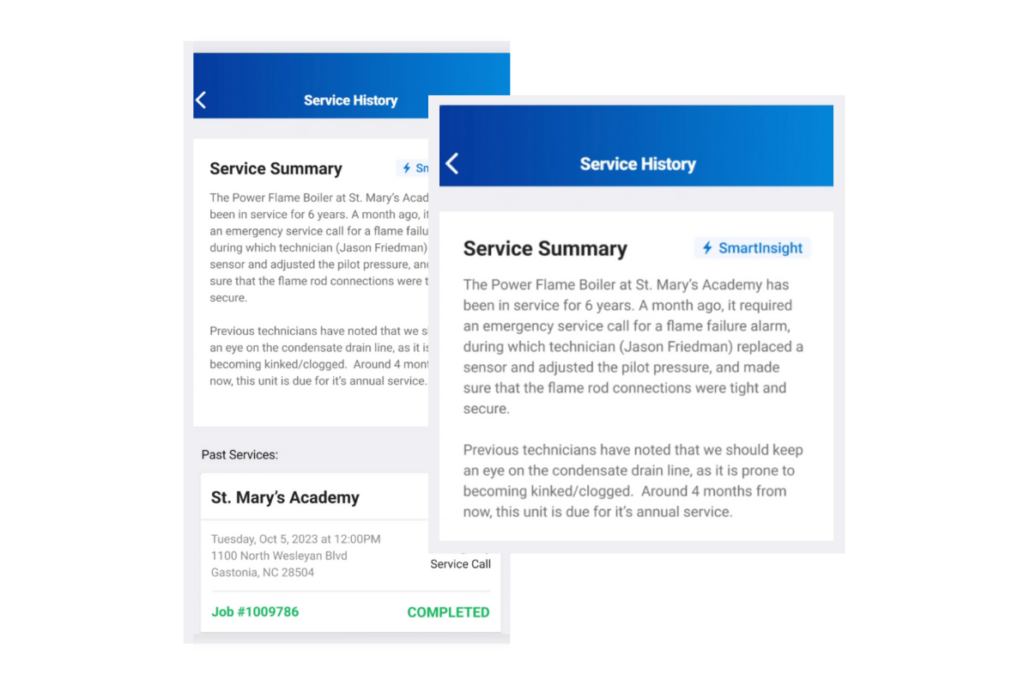
Technician productivity automatically creates a comprehensive service history summary and polished, customer-ready reports after each job, summarizing work delivered in easy-to-understand terms without extra office staff time
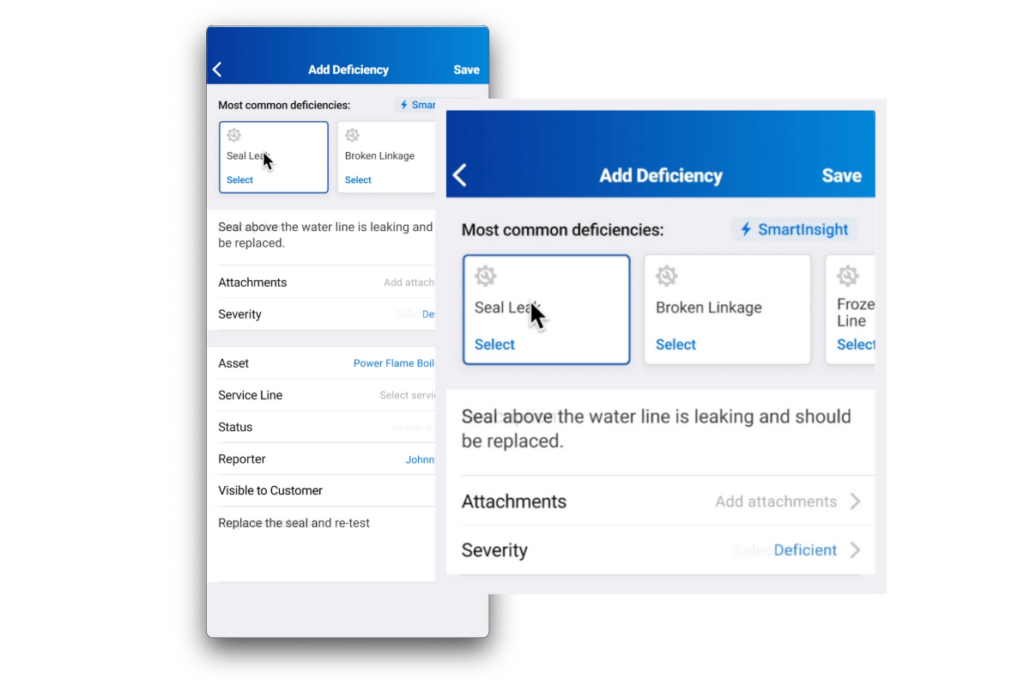
Predictive maintenance arms technicians with the insights they need to solve problems quickly with recommendations based on historical asset performance and frequently reported issues
“Technology is more important than ever for contractors to run an efficient operation and deliver exceptional customer service,” said Billy Marshall, CEO of ServiceTrade. “Smart AI takes our platform to the next level, using AI to boost operational outcomes, maximize labor productivity, and ensure customers receive the best possible experience.”
ServiceTrade Smart AI will be rolling out in phases over the coming months. For a preview of Smart AI
Attend the Digital Wrap Conference, April 29th-May 1st, in Austin, TX, to network with leaders in fire and mechanical contracting and to get hands-on access to new AI features