





13 Best Mechanical Contractor Software Tools for 2026
Mechanical inspections don’t look the same for every contractor. Residential teams need to move fast, stay consistent, and clearly communicate results to customers. Commercial contractors often need more capabilities—like detailed asset tracking, preventative maintenance, and help staying compliant. Many mechanical businesses sit somewhere in the middle, handling a mix of both.
The problem? Most inspection software isn’t built to handle all of that equally. Some platforms are clearly residential-first. Others are driven by construction or financial workflows. Only a few are designed to tie inspections directly into service, repairs, and ongoing maintenance.
This guide compares 12 mechanical inspection software tools used by both residential and commercial contractors in 2026. Each tool approaches inspections and service workflows differently, so understanding those differences can help you find the right fit for your operation.
- ServiceTrade
- BuildOps
- Salesforce
- BlueFolder
- Coins (The Access Group)
- XOi
- Simpro
- Acumatica Mobile
- ServiceFusion
- ServiceTitan
- Smart Service
- Jobber
- FieldEdge
1. ServiceTrade – The leading platform built for commercial mechanical contractors

ServiceTrade is built specifically for commercial mechanical contractors, with inspections fully embedded into everyday service workflows—not treated as a separate process. For more than 13 years, ServiceTrade has focused exclusively on commercial service, supporting HVAC and mechanical teams with complex assets, recurring maintenance, and long-term customer relationships.
Technicians complete digital, code-compliant inspections directly in the ServiceTrade mobile app. Once an inspection is finished, results automatically turn into professional, customer-ready reports—no manual paperwork or follow-ups required. Because inspections, service calls, and maintenance all live in the same app, technicians don’t have to switch tools, which simplifies training and improves accuracy in the field.
When issues are identified, ServiceTrade captures them as deficiencies and converts them directly into ready-to-quote repairs. Office teams get real-time visibility into inspection progress, revisions, and next steps, making it easier to manage inspections at scale. Unlike inspection-only tools, ServiceTrade connects inspections to quotes, repairs, preventative maintenance, scheduling, and compliance reporting—all in one platform.
Pros:
- Built specifically for commercial mechanical contractors
- Fast, proven implementation (8–12 weeks)
- High customer satisfaction (97%)
- Digital, code-compliant inspections in one mobile app
- Inspections flow directly into repair quotes
- One system for inspections, service, and maintenance
- Real-time visibility for office and field teams
- Reliable platform with 99.99% uptime
Cons:
- Only for commercial contractors
- US-based and primarily North America-focused
- Not a full ERP or accounting system
Biases aside, we believe ServiceTrade is the best platform for commercial mechanical inspections and service. Still, we encourage you to explore the alternatives below and choose the solution that best supports your operation.
Discover why leading contractors choose ServiceTrade.
2. BuildOps – A construction-driven solution for commercial mechanical operations
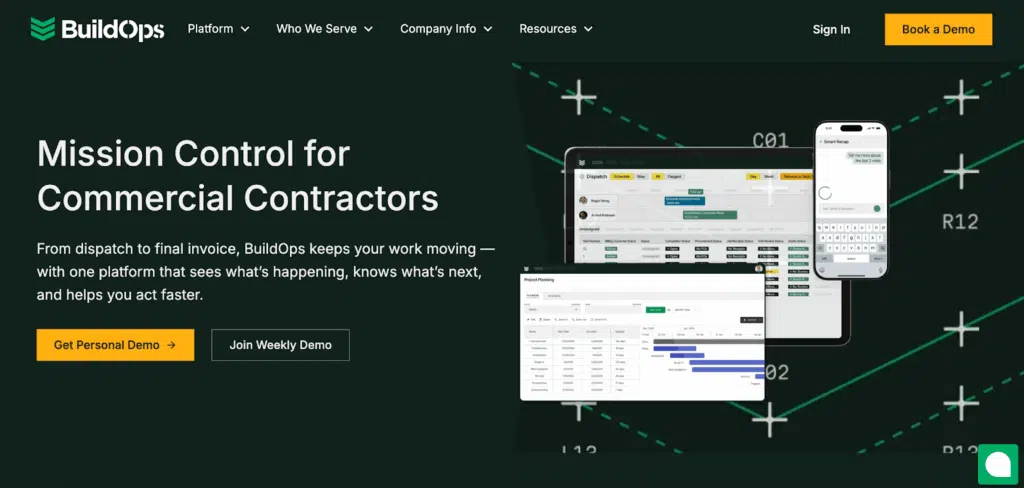
BuildOps is a commercial-focused platform designed for contractors that manage large projects, installs, and construction-heavy work, with service capabilities layered on top. It brings project management, scheduling, dispatch, and job costing into one system and works best for mechanical contractors whose business leans toward construction and retrofit projects. Teams that are more service-, inspection-, or maintenance-driven may find it less streamlined day to day — a common reason contractors start comparing BuildOps competitors.
Pros:
- Built for commercial contractors
- Strong project management and job costing
- Designed for construction-heavy mechanical operations
Cons:
- Construction-first, not service-first
- Inspections aren’t a core strength
- Simple service work can take extra steps
See our detailed ServiceTrade vs BuildOps comparison for a closer look.
3. Salesforce – An enterprise-first platform for commercial mechanical teams

Salesforce is an enterprise CRM that can be configured to support field service through Salesforce Field Service, often used by large mechanical contractors to manage customer data, assets, work orders, and scheduling. It is firmly commercial-focused and works best for organizations with dedicated IT resources. While highly flexible, Salesforce is not purpose-built for mechanical contractors, and many inspection and service workflows require significant customization or third-party tools.
Pros:
- Built for large, commercial organizations
- Highly configurable to match complex processes
- Strong CRM, asset, and data management capabilities
Cons:
- Not purpose-built for mechanical contractors
- Requires customization and IT resources to support service workflows
- Can be complex and costly to implement and maintain
4. Blue Folder – Lightweight software for commercial mechanical dispatch

BlueFolder is a legacy, commercial-focused service management platform used by mechanical contractors to handle basic dispatching, work orders, and job tracking. It’s often chosen by commercial HVAC and mechanical teams that want a low-cost, straightforward system without a lot of setup or complexity. BlueFolder helps office teams schedule technicians, track jobs, and keep customer records organized, but it’s intentionally limited and built on older technology. As a result, contractors with inspection-heavy workflows, preventative maintenance programs, or complex asset and compliance requirements may find its functionality limited as their operations grow.
Pros:
- Built for commercial service teams
- Simple dispatching and work order tracking
- Easy to use with minimal setup
Cons:
- Outdated interface and legacy technology
- Limited reporting, analytics, and accountability
- Not built to scale
5. Coins (The Access Group) – Financial control for commercial mechanical contractors
Coins is an ERP platform built for commercial construction and mechanical firms that need strong control over accounting, job costing, and project finances. It’s typically used by office teams to manage the back office, not by technicians in the field. While Coins can support service-related financial tracking, it isn’t designed for inspections, scheduling, or day-to-day service work, so many mechanical contractors pair it with a service-focused platform.
Pros:
- Built for commercial mechanical firms
- Strong accounting and job costing
- Handles complex projects well
Cons:
- Not built for field service or inspections
- Limited support for technician workflows
- Requires another system for service work
6. XOi – Data intelligence for commercial mechanical teams
XOi is a data intelligence platform that helps mechanical contractors capture job details through photos, videos, and structured documentation. It is typically used alongside an existing service platform to improve visibility, communication, and service history. XOi does not handle scheduling, inspections, billing, or preventative maintenance on its own, making it a complementary tool rather than a complete service management solution.
Pros:
- Strong equipment data capture + enrichment
- Speeds up surveys/quoting with structured equipment data
- Integrates with many existing FSM platforms
Cons:
- Not a full FSM platform
- Does not handle scheduling, dispatch, inspections, or billing
- Adds another tool for technicians to manage
7. Simpro – A project-heavy platform for commercial trade contractors
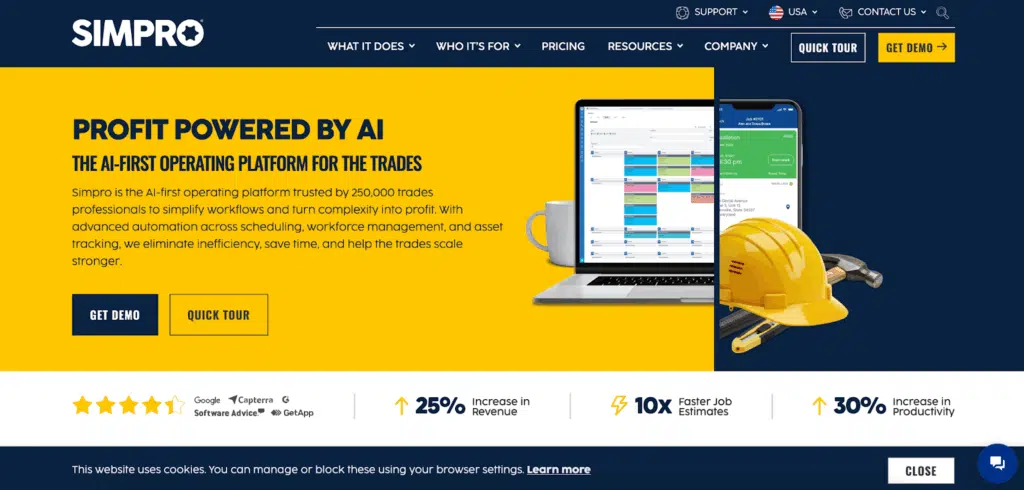
Simpro is a field service and project management platform used by commercial trade contractors, including mechanical teams that handle a mix of installs, projects, and service work. It offers tools for estimating, job costing, scheduling, asset tracking, and invoicing, and is often adopted by contractors looking to manage both field operations and project financials in one system. That said, Simpro is construction-first, and mechanical contractors who are more focused on service, inspections, or preventative maintenance often find the platform complex and harder to use day to day. Because Simpro is not US-based, some contractors also report support and market-fit challenges, particularly around US-specific service workflows.
Pros:
- Supports commercial mechanical and trade contractors
- Robust construction and project management tools
- Useful for project-heavy operations
Cons:
- Construction-first, not service-first
- Steep learning curve with a complex interface
- Not US-based, which can create support and responsiveness challenges
8. Acumatica Mobile – A back-office system for commercial mechanical teams
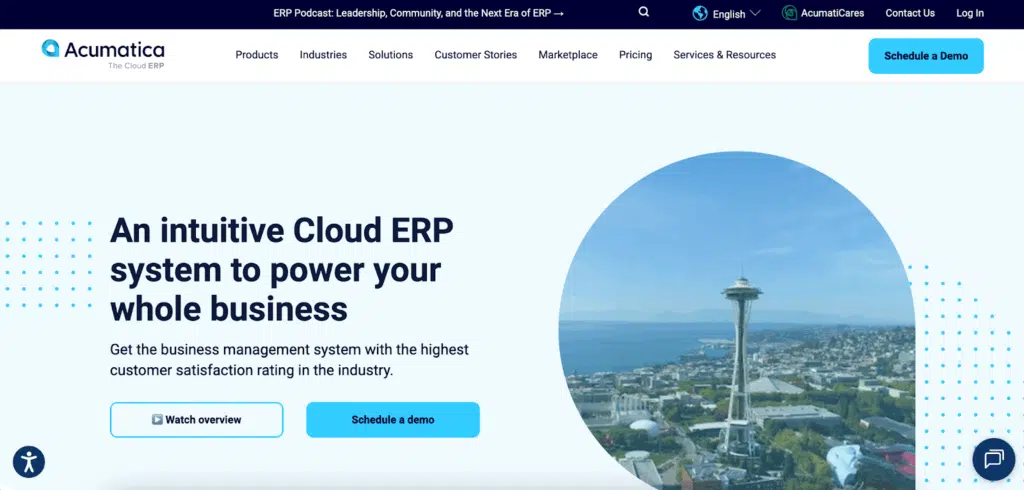
Acumatica is a cloud-based ERP system used by commercial mechanical contractors to manage accounting, job costing, inventory, and other back-office operations. It’s often chosen as a financial and operational backbone rather than a day-to-day service tool. While Acumatica offers field service and construction modules, it’s ERP-first, not FSM-first, and many contractors find the mobile experience for technicians lacking. Inspections, service workflows, and preventative maintenance typically require configuration, add-ons, or integrations, and implementations can be complex—especially for teams looking for a streamlined, field-friendly solution.
Pros:
- Strong accounting and financial management
- Supports complex commercial operations
- Flexible ERP platform with customization options
Cons:
- ERP-first, not built for service workflows
- Weak mobile experience for technicians
- Complex implementation and setup
9. ServiceFusion – Built for residential and light commercial service teams
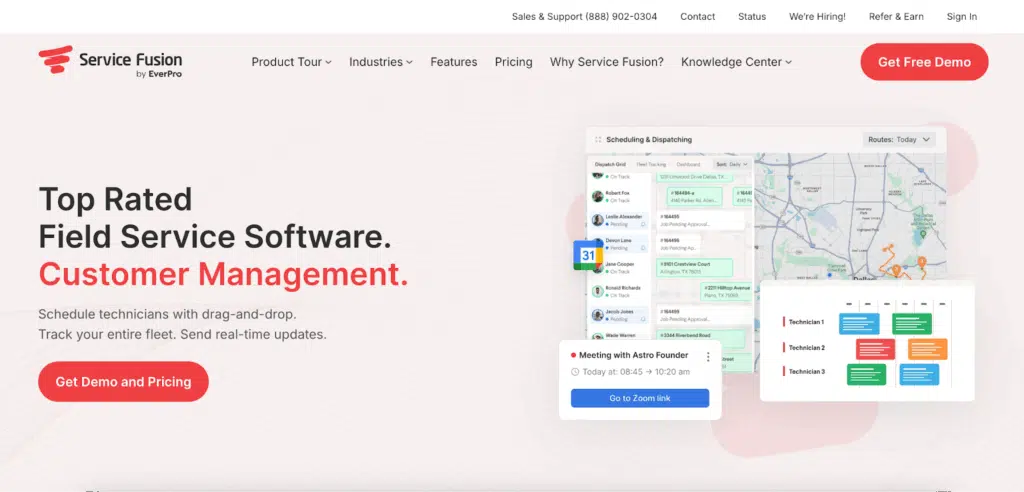
ServiceFusion is a field service management platform designed to help mechanical contractors manage scheduling, dispatch, invoicing, and basic service operations. It’s most commonly used by small to mid-sized service teams looking for an all-in-one tool that’s relatively easy to get started with and budget-friendly. While ServiceFusion can support some commercial mechanical work, its workflows are largely geared toward residential and light commercial service. Contractors with inspection-heavy operations, preventative maintenance programs, or complex commercial requirements may find the platform limiting as their business grows.
Pros:
- Affordable, all-in-one service platform
- Straightforward scheduling and dispatch tools
- Easy to get started for small teams
Cons:
- Residential-focused workflows
- Limited inspection and preventative maintenance capabilities
- Less flexible for complex commercial operations
10. ServiceTitan – A residential-first FSM with added commercial capabilities
ServiceTitan is a field service management platform originally built for residential trades that has expanded into commercial service. It offers strong scheduling, dispatch, and technician productivity tools and works well for contractors running residential and light commercial work. For commercial mechanical contractors, however, many workflows still reflect its residential roots — which is why teams managing complex billing, multi-site customers, or long-term service contracts often explore ServiceTitan alternatives.
Pros:
- Strong scheduling and dispatch tools
- Works well for residential and light commercial work
- Well-known platform with a large user base
Cons:
- Built residential-first, not commercial-first
- Complex billing and multi-location customers require workarounds
- Higher cost than many alternatives
See our detailed ServiceTrade vs ServiceTitan comparison for a deeper dive.
11. Smart Service – A QuickBooks add-on for small mechanical service teams
Smart Service is a QuickBooks-based add-on designed to help mechanical contractors add basic scheduling, dispatch, and work order management on top of their accounting system. It’s typically used by small service teams that want to keep everything closely tied to QuickBooks and don’t need a lot of advanced service functionality. While Smart Service can support simple mechanical service work, it isn’t built for inspections, preventative maintenance programs, or complex commercial operations, and many contractors outgrow it as their service needs become more sophisticated.
Pros:
- Very low cost
- Integrates directly with QuickBooks
- Simple scheduling and work order tracking
Cons:
- Completely dependent on QuickBooks
- Limited support for commercial mechanical workflows
- Quickly outgrown as operations scale
10. Jobber – A residential service tool for small mechanical teams
Jobber is a field service platform built for small residential contractors, including HVAC and other mechanical trades just getting started. It focuses on basic scheduling, invoicing, and job tracking, making it easy for small teams to manage day-to-day residential service work. While Jobber works well for simple residential jobs, it isn’t designed to support commercial mechanical operations, and most contractors outgrow it as soon as they need multi-location customers, asset tracking, or preventative maintenance at scale.
Pros:
- Easy to use for small residential teams
- Quick setup with basic scheduling and invoicing
- Affordable option for early-stage businesses
Cons:
- No support for multi-location commercial customers
- Limited asset tracking and preventative maintenance
- Not designed for complex commercial workflows
13. FieldEdge – A residential-first service platform adapted for mechanical contractors
FieldEdge is a field service management platform originally built for residential HVAC, plumbing, and electrical contractors. It focuses on scheduling, dispatch, invoicing, and technician workflows, and is often used by smaller to mid-sized service teams. While FieldEdge can support some commercial work, its workflows are largely shaped by residential service models. For commercial mechanical contractors, especially those managing inspections, preventative maintenance, and multi-site customers, FieldEdge can feel limiting as operations grow more complex — prompting many teams to look at alternatives to FieldEdge.
Pros:
- Easy-to-use scheduling and dispatch tools
- Works well for residential and small service teams
- Straightforward setup for basic service operations
Cons:
- Built for residential, not commercial mechanical contractors
- Limited support for inspections and preventative maintenance at scale
- Less flexible for multi-location customers and complex billing
Choose a Tech Solution Built for You
Your business needs software that fits how you actually operate, not a one-size-fits-all tool built for someone else. While some platforms may work in certain situations, commercial contractors often need something more purpose-built.
ServiceTrade is trusted by 1,300+ commercial contractors, including hundreds of commercial mechanical teams, because it’s built around the realities of commercial service. Inspections, assets, preventative maintenance, and service work all live in one platform, so teams aren’t forced to juggle tools or rely on workarounds. The result is faster inspections, smoother service workflows, and better visibility across the business.
Ready to see if ServiceTrade is the right solution for you? Book a demo today to experience the difference.

In 2025, commercial contractors faced rising labor constraints, tighter margins, and increasing customer expectations. Growth required more than adding headcount or chasing more work. It required operating smarter at every level of the business. Contractors using ServiceTrade focused on the fundamentals that drive scalable performance: helping technicians spend more time on billable work, giving office […]
If you sell service work to customers with multiple facilities, you know how complicated proposal management can get. Different locations, different scopes, different service levels… and usually a whole lot of manual effort just to keep everything straight. That’s why we’re excited to enable Multi-Site Proposals for all SalesManager customers, a powerful new way to […]