





From Service to Safety: How Veterans Strengthen the Fire Protection Industry
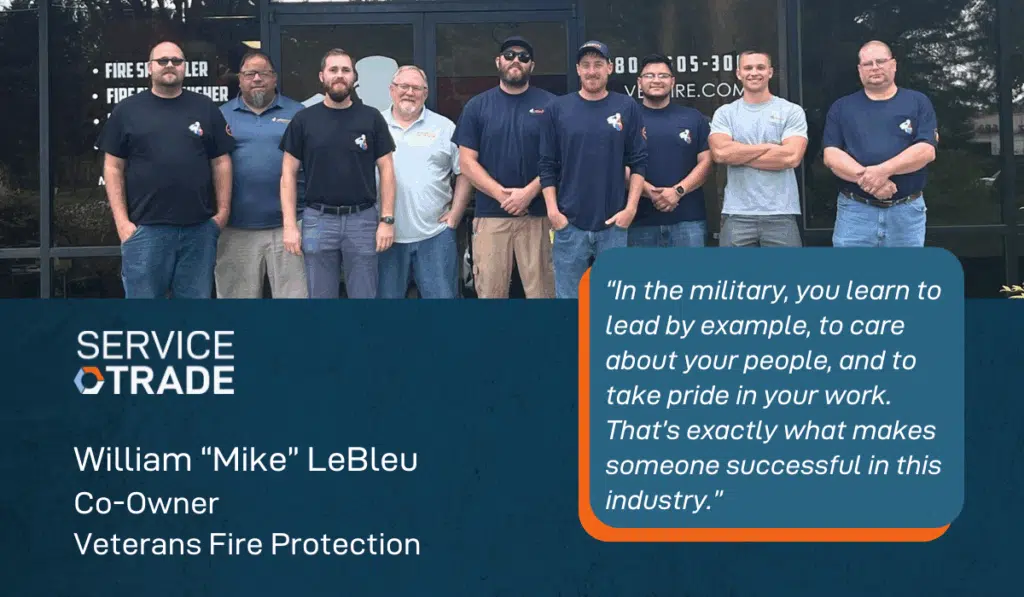
When William “Mike” LeBleu left the U.S. Army in the early 1980s, he wasn’t sure what would come next. Like many veterans, he carried valuable lessons in leadership and discipline—but not a clear path for how to use them in civilian life.
A friend pointed him toward a job inspecting fire extinguishers at the Medical College of Virginia/VCU, and before long, Mike discovered a calling that would become a lifelong career in fire protection. “The military gave me drive and discipline,” he said. “That’s what helped me build a career, a company, and a team that takes pride in keeping people safe.”
Now the co-founder of Veterans Fire Protection, Mike leads with the same principles that shaped him in uniform: reliability, accountability, and service to others. “When you’re taking care of fire protection systems, people’s lives are on the line,” he explained. “This work demands pride and attention to detail, because what we do keeps people safe.”
To Mike, the word service bridges his two worlds. “In the military, service means taking care of your fellow soldiers,” he said. “In this work, it means taking care of your community—protecting people and property.”
It’s a mission that continues to resonate across the trades, where leadership, teamwork, and commitment matter just as much as technical skill. “I’d fill my company with veterans if I could,” Mike said. “Their discipline and dependability are exactly what this industry needs.”
STOP TYPING. Start Scanning. Technicians have always done whatever it takes to get the job done, but manual asset entry has never been the part they enjoy. Between faded serial plates, tiny lettering, and tight schedules, capturing equipment details by hand slowed everyone down. And when the data wasn’t complete or accurate, the office was […]
You’ve invested in software. You’ve digitized processes. You’ve built dashboards. Yet somehow, your team still asks, “Whose numbers are right?” You’re not alone. Many commercial service contractors invest heavily in data tools only to see minimal ROI. The problem usually isn’t the technology—it’s one of these five critical failures. Failure #1: Skipping Stages The mistake: […]